
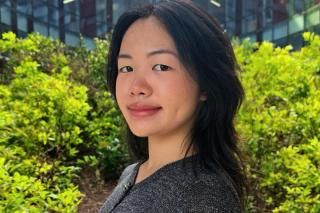
“Throughout my childhood, I have always been encouraged to understand the question ‘why?’ I believe that the understanding of natural phenomena not only enables much of our understanding of the world around us but also enables new technology every day,” says Diepanh Do ’28, a physics and mathematical sciences double major, data science minor, and international student from Vietnam.
“I came to Simmons as a data science major, but I became increasingly interested in my math classes. I also found myself spending a lot of time pondering the more fundamental questions of the universe, rather than the questions of the field of data science, and I realized that I really like physics,” she says. “I personally really enjoy doing physics research; it does not only test my curiosity but also teaches me about resilience and collaboration.”
During her first year at Simmons, Do attended an event at which professors from the Departments of Biology and the Chemistry and Physics gathered to share the research they conduct in their laboratories.
“Professor Jason White was one of them,” Do recalls. “I was excited by his research on biomedical ultrasound experiments, and was pleased that Simmons offers research opportunities to students. I tried it out, and realized that the field of physics would help me ask the big questions of fundamental phenomena and provide more resources to expand or improve technology for our lives to function better.”
This project led to Do obtaining a letter of recommendation for a summer research opportunity at the University of Maryland College Park.
Recently, Do started a new project in Professor White’s lab that focuses on experimenting with Lamb waves for monitoring intracranial pressure.
Do is pleased to have gained research experience as an undergraduate. “At Simmons, it is pretty easy to join labs,” she says. “I did it in my first year, which has given me an experimental and hands-on learning opportunity.”
Researching Neutrinos
During the past summer, Do engaged in research at the University of Maryland’s Department of Physics. The research focused on neutrinos, which, Do explains, “are elementary particles, and abundant. As we are living our normal lives, neutrinos reach Earth and stream through our bodies.”
Do’s research project, “Search for Neutrino from Fast X-ray Transients with IceCube,” examines how Fast X-ray transients (basically messengers from the universe), which are an interesting class of very bright flares, can provide evidence that neutrinos are returning from an astro-physical phenomenon or object, such as exploding stars or merging black holes.
“If we can see astrophysical neutrinos from them, we will have more evidence about the possible source from which they both came,” she explains. “This will provide us a glance at extragalactic phenomena that will fit into the bigger picture of the evolution of the universe.”
Do applied hypothesis testing to test the number of astrophysical neutrinos necessary for the dataset to be considered containing a signal.
“This is a statistics problem, and I spent lots of time running these trials to determine a reasonable number,” she adds. “Additionally, IceCube is a complicated experiment, so I also spent most of the time trying to understand and appreciate the science and engineering behind it.”
For Do, researching neutrinos enables her to ponder fundamental questions about the universe.
“I think about where we come from, what our position is within this universe. And I think relying on neutrino astronomy is a brilliant idea,” she says. “We don’t have that many opportunities to look at the universe and understand what is going on out there. But then here on Earth we actually have some things that reach us from a very far distance. So, this research is valuable to help understand what is happening in the universe.”
The University of Maryland’s Department of Physics is one of the collaborators/partners of The IceCube Neutrino Observatory. Also known as IceCube, this neutrino observatory was developed by the University of Wisconsin–Madison and constructed at the Amundsen–Scott South Pole Station in Antarctica. The principal investigator of IceCube, Francis Halzen, recently received the Nobel Prize in Physics.
“For me, this was very exciting; it does not even seem like reality,” says Do about the Nobel Laureate. “There are a lot of collaborations and partnerships with IceCube, and the University of Maryland is one of them. There are so many people putting their efforts into these experiments, day and night. I feel like this is a very important recognition for Francis Halzen’s brilliant idea, and for everyone involved. IceCube has contributed so much to the field of neutrino astronomy.”
Choosing Simmons
When it came to selecting a college to attend, Do realized that “Simmons is a really unique school. We are a smaller size and a women-centered college,” she says. “And the Boston location is amazing — not only for academics and research, but also for technology, finance, and other opportunities.”
Most of all, Do appreciates the supportive atmosphere of Simmons. “Coming to college as an international student from Vietnam, I knew that I wanted more help, support, and community. I knew that since I am new here, I would face challenges and would need support. That’s the biggest reason why I came to Simmons.”
Moreover, Do has had the opportunity to interact with many other international students at Simmons. “I find this really nice, and I have been able to learn about other cultures while being a student here,” she adds.
Faculty Support
Do appreciates interactions with Simmons faculty. “Because of the small size of Simmons’ courses, it is easy to speak with faculty. When I need help, not only with my coursework but also when I need to make decisions for my career or just navigating resources, faculty are always there to help,” she says. “I can just come to office hours and my professors are ready to answer questions for me.”
Thus far, Do has enjoyed all of her Simmons STEM courses.
“My courses in the sciences have provided different lenses through which to study things,” she says. “Every semester I am finding new ways to approach topics that interest me.”
Moreover, Simmons faculty have supported Do in procuring opportunities beyond the classroom.
“My professors also play a crucial part in helping to get me the research internship [at IceCube],” she says. “They taught me how to do research, wrote me letters of recommendation, and encouraged me when I was unsure whether to take the opportunity or not.”
Dream Big
Do’s advice to aspiring scientists is “to just start off by noticing what interests you every day, and take note of the questions that you keep pondering every day. Those are the areas that you want to research and study more.”
Ultimately, Do says, “I would tell people to dream big and stay committed to your dreams.”