
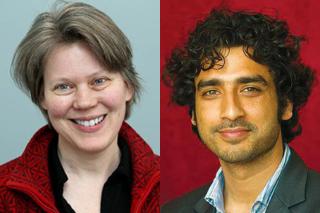
Why study writing and literature at Simmons? Professor Renée Bergland and Associate Professor of Practice Farooz Rather share their thoughts on what makes Simmons’ Bachelor of Arts in Writing and Bachelor of Arts in Literature programs unique.
“Part of what we are doing in the Department of Literature and Writing is to give students the language that enables them to ground themselves in the traditions they come from and clearly communicate in an age which feels increasingly diffuse and distracted,” says Associate Professor of Practice Farooz Rather. “Our aim is to train students in a way so that they can master the art of articulating complex ideas, the beginnings of which they already carry within themselves.”
Professor Renée Bergland notes that Simmons attracts a vibrant student body. “We tend to draw students who were a little quiet in high school and want to express themselves and find their voice at Simmons,” she says. “The students who grew up in small New England towns have very different experiences from those who lived in Boston or New York City.”
Perhaps drawn to Simmons by small class sizes and a supportive community, students also find a welcome diversity in the reading materials and their classmates.
“These literature and creative writing courses are conversations with representatives of literature from around the world,” says Rather, who notes the diversity of the literature and the students in those classes as vital for rich in-class discussions. “It’s a very broad conversation that happens in these courses, gathering different perspectives. In each session, it's like voices from different literary traditions talking to each other."
Fiction, Poetry, Non-Fiction, and Beyond
As undergraduate programs at Simmons focused on the arts, the Bachelor of Arts in Literature and Bachelor of Arts in Writing provide practical applications for students, in addition to a deep dive into the art of literature and writing.
“The writing degree isn’t just about writing fiction,” notes Bergland. “Our students learn about writing in practical and creative ways, as well as learning how the publishing industry functions. We also have small classes, allowing students to get to know each other and their professors very well. They become this tight-knit group in each class, and I find that special.”
For example, “Public Humanities Writing” (LTWR 103) focuses on magazine articles, interviews, book and movie reviews.
Simmons offers creative writing courses in fiction (LTWR 107) and poetry (LTWR 109) (as well as higher-level workshops in both), the writing courses include “Contemplative Writing for Self-Knowledge” (LTWR 108) and “Environmentalist Writing” (LTWR 201) to broaden the students’ scope of what their writing can achieve. “Reclaiming Home” (LTWR 202) aims to develop the students’ critical eye toward postcolonialism in literature, honing their own writing with the inspiration of texts from around the world.
“In addition to acquainting students with ideas of rootedness and rootlessness, displacement and exile, the generative workshop is built in a way so that students develop their story in multiple iterations, contemplating their relationship with home as they build and scrutinize the trajectory of their characters,” says Rather. “That focus on the process of writing is unique. Especially with a workshop class, we walk them through the process of both giving and receiving critique, step by step.”
Rather enjoys teaching the required “How to be a Writer” (LTWR 210) course, which exposes students to a range of theoretical essays about the act of creative writing.
“In this course, approaching the difference between the epic and the novel through the idea of how the novelist sees the present as a poetic possibility, whereas the writer of the epic is re-telling a story that's already complete,” he says.
His students choose their favorite character from epics, such as Homer’s The Odyssey and Shahnameh by the Persian poet, Ferdowsi. “They write a short story by grafting their favorite character to their own, contemporary contexts and write about them in a novelistic way.”
While the writing and literature majors are separate, Bergland notes a healthy amount of cross-over between them. Both tracks build writing skills, and both emphasize “the discipline of reading carefully and attentively,” says Rather. “That skill is important for both literature and writing.”
A Transformative Capstone Experience
Reading and responding to one another’s work is an important practice, and the focus of all “workshop” courses. Writing classes meet regularly to create what Rather calls “small communities of trust.” By the end of the semester, “the pieces belong to all fifteen students in the class, as they’ve seen different iterations of it and offered feedback. The pieces grow over the course of the semester,” he says.
“They learn how to give feedback and support each other,” says Rather, who offers prompts to encourage students to offer specific critique of their classmate’s writing. “Rather than generalized praise, we get more specific and talk about how different constituent elements work within a short story. For instance, how the setting reinforces characterization and how the psychological state of the character pervades the mood. Students start out shy, but as the workshop progresses, they build trust and their feedback becomes more detailed, honest, and helpful.”
Bergland values the opportunity to see students in their first semester course, “Approaches to Literature” (LTWR 199) and again in “Advanced Seminar in Literature and Writing” (LTWR 390).
The advanced course, which students usually take in their junior or senior year, serves as a Capstone for both the literature and writing programs.
“Each student completely designs their own project,” says Bergland of the Capstone. “Students write novels, memoirs, screenplays, chapbooks of poetry, or collections of long-form journalistic essays that they want to publish in the Guardian. Others do a scholarly piece focused on literary criticism or research to help them gain admission into graduate programs.”
At the end of Spring semester, the department holds a Colloquium, and each Capstone student has the chance to present their work for an audience of family and friends. “I love to see how the students have grown,” says Bergland.
Boston as Literary and Professional Hub
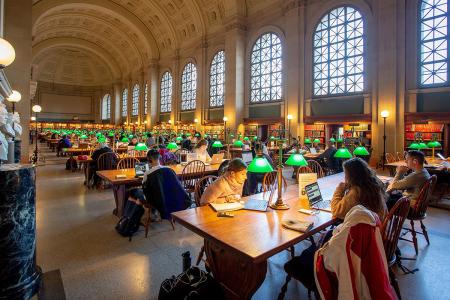
Boston is a perfect place to study writing, for its literary history and culture, its independent bookstores, vibrant library system, and resources for local writers.
“Our students have a supportive community at Simmons, and access to a community of readers and writers in Boston,” says Bergland.
Rather notes that the best writers often visit Boston on their book tours; local bookstores and libraries frequently feature authors, both local and from further afield. “Boston’s literary culture creates opportunities for students,” says Rather. “By inviting writers to my classes, I'm able to create an interface between the work of my students and the experts in the field. My students enjoy the experience of interacting and sharing the reading space with established authors.” Leila Aboulela, author of River Spirit (Grove Press, 2023), and more recently Lydia Kiesling, author of Mobility (Crooked Media Reads, 2024), spoke to Rather’s classes. In recent years, the University has hosted Tracy K. Smith, Edwidge Danticat, and R. F. Kuang for readings and lectures on campus.
Boston also has a wealth of publishing companies, newspapers, public libraries, and academic institutions where writers can pursue career paths in publishing, journalism, marketing and communications, and teaching.
“While many students write novels and poetry, they also explore additional career opportunities,” says Rather. “It’s difficult to support yourself as a writer, alone. Having these opportunities creates a path forward.”
Writing is Vital in the Age of AI
“I see literature and writing programs as a refuge from AI (artificial intelligence), a place where people can really think for themselves,” says Bergland. She cites a recent New Yorker piece that likened education with going to the gym — a place to build mental strength and abilities. While she doesn’t encourage ignorance of new technology, that doesn’t mean we need to adopt it without conscious thought.
“You have to engage with the modern world and think about it and how to respond to it,” says Bergland. “What worries me most about AI is that people are letting AI do the work for them, which will make them weak thinkers. Our students work hard at expressing themselves and thinking for themselves. These skills will grow more valuable as they grow more scarce.”
While Rather shares concerns of how AI adoption will impact literacy in the world at large, he sees a counterpoint to those shortcomings in the vibrant, committed students in his classroom. “We have students who really love writing and literature. They want to do that work, even though it’s not easy. They are motivated to read and write and think for themselves.”
The value of that ability to communicate will only increase as daily communication and content is ceded to lackluster AI intelligence. “Our students will learn how to make an argument that is actually persuasive, not just based on statistics of what the average person would say.”
Bergland is optimistic that the prevalence of AI “slop” content will only enhance the value of original thought. “People will feel the real need to express themselves in original thoughts, to access their own voice.”
And Boston is the perfect place to make those discoveries. Bergland loves reading in the courtyard of the Boston Public Library, beside the fountain. “I love to go there to grade papers. It’s beautiful to sit outside in the spring and fall,” she says.
“The joy of reading a great novel is completely losing yourself in the experience. These courses preserve that experience,” says Rather, who particularly enjoys walking and sitting to read by the reservoir near Chestnut Hill. Rather also takes his students outdoors for at least one session per semester.
“We sat outside without any technology, reading poetry by the Romantic poets,” he recalls. “Just sat by the water reading Shelley and Keats aloud to the trees.”