
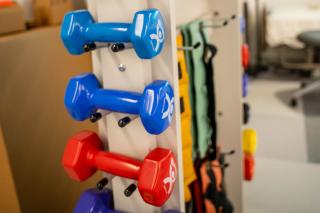
Students in the doctor of physical therapy (DPT) program at Simmons begin integrated clinical experiences during their first fall semester. These experiences are scheduled in the six-week blocks toward the beginning or end of the semester (“block one” or “block two”).
“Our clinical instructor was a Simmons graduate and understood where we were at in terms of our skills,” notes Ally Rebelo ’28DPT. “By week two or three, they would allow us to practice a technique we had recently learned in class.”
Zuzanna Misztela ’28DPT echoes this direct connection between clinical and classwork.
“My instructor would ask what I was learning that week, and allow me to practice my skills on the patients, with their consent,” Misztela says. “For example, after learning about the shoulder in class, the next time at a clinical experience there was a patient who allowed me to go through the process of mobilizing the shoulder. That experience solidified all that I was learning in class about that body part.”
Integrated Clinical Experiences: Outpatient
For their integrated clinical experiences, the students were onsite for a full day of clinical integration once per week for six weeks. Ruddy and Rebelo had their experience at a private, outpatient clinic: Houghton Physical Therapy in Attleboro, Massachusetts.
“We saw each patient for 45 minutes. It was a good set up for students,” says Ruddy. This included a clinical instructor who brought the students through the process, with thorough explanations. “We were able to make a connection with the patients we saw there,” adds Rebelo.
Rodriguez visited Bay State Physical Therapy in Boston’s North Station once per week for 8-hour shifts.
“I learned a lot of applied, hands-on skills,” says Rodriguez. “The clinical instructor was great at letting me try things too, after demonstrating how things were done, like soft tissue massage and muscle release. Six weeks isn’t that long, but you do get to see the patients’ progress.”
Misztela went to Spaulding Outpatient Center in Boston’s Downtown Crossing, where she also saw patients in 45-minute blocks.
“I was able to work with one person at a time and put all of my energy toward them,” she recalls. “I learned the plan of care for each patient, and was able to see them regularly and witness their progress.”
She also had the opportunity to learn about Graston Technique, in which the therapist uses a stainless steel instrument to treat soft tissue.
Integrated Clinical Experiences: Inpatient
For her current inpatient clinical experience, Misztela is placed on Beth Israel Deaconess Medical Center’s cardiac floor, with patients who have experienced heart failure, heart attacks, or undergone bypass surgeries.
“We’re learning how we can help in the recovery process,” she says, noting that other integrated clinical experiences this semester take place in varying inpatient settings, such as subacute rehabilitation.
“I saw a patient the other day who was recovering from a heart attack,” says Misztela. “As a PT, I was monitoring how well they were breathing and if they experienced any fatigue. We walked around with them to see if the body can tolerate that much exercise. We talk about what the patients will face at home, like a flight of stairs. We have to make sure they have the stamina for that after an intense cardiac event. It’s about looking at the full picture to recover their quality of life: can they take out the garbage? Go grocery shopping? We need to make sure they are ready to resume their activities of daily living safely.”
Rebelo is also on a cardiac unit at Brigham & Women’s Hospital. “There are a few floors, depending on whether patients are recovering from cardiac surgeries, like implantation of pacemakers. It’s really interesting to see how different it is when compared to outpatient orthopedics.”
She saw a patient who had undergone an artery bypass graft. “I had to teach them how to use their arms to get out of bed, and how to get out of a chair properly, before they could be cleared to go home or to a rehabilitation facility.”
She has worked closely with nurses to manage lines and tubes during PT sessions to maintain patient safety.
In these settings, a large part of a PT’s role is patient education.
“For my integrated clinical experience rotation, our job is to explain what cardiac event occurred and what that entails,” says Ruddy, “and how this might affect them long term. They need to understand what is ahead in order to take the right next steps.”
This can also include teaching them how to use devices. “We’re teaching people how to walk with canes, crutches, or walkers,” adds Rodriguez. “We talk about what their homes look like, and make a plan for what devices they will use upon discharge.”
Rodriguez notes that PTs work closely with the nurses on staff, and often help patients with any referrals they may need for further treatment. Learning how to conduct that interprofessional communication is crucial.
“When you finish with a patient, you need to hand them off to their nurse,” says Ruddy. “You tell the nurse if they are sitting in bed, how their vitals are. You have to make sure nothing is being missed.”
In her clinicals, Misztela has interacted with doctors, nurses, pharmacists, social workers, and occupational therapists.
“I’ve met with every person working with the patients I visited,” she says. “We discuss who will be discharged. PT has to assess if they are ready to go home or to another form of therapy to continue treatment, so there is a lot of communication between PT and doctors and nurses to figure out what is best for the patient.”
Ruddy is amazed by the opportunities available to Simmons students. “We’ve had clinical experiences at these huge hospitals — Beth Israel Deaconess Medical Center and Brigham and Women’s Hospital — as students! It’s a unique opportunity to be connected to all of these Boston hospitals.”
Why Simmons for a DPT?
Ruddy, Misztela, and Rebelo opted for the Accelerated Program in Health and Exercise Science & Physical Therapy (3+3), which allows them to complete their undergraduate studies in three years before beginning the PT portion.
“With the 3+3 program, you don’t have to worry about doing the application process again,” says Rebelo. “It was a really nice transition from undergrad to grad, as we already have connections to professors and advisors.”
Rodriguez chose to come to Simmons after completing her undergraduate degree, and has enjoyed her time at Simmons. In addition to supportive faculty — Professor of Practice Justin Jones, Professor of Practice and Physical Therapy Department Chair Stacey Maguire, and Assistant Professor of Practice Matthew O'Rourke — Rodriguez has been impressed by the nimbleness with which feedback is heard and positive changes implemented.
“I’m a graduate assistant for the musculoskeletal lab,” says Rodriguez. “The new cohort is bigger than ours was, and I’ve seen a lot of changes made for them, based on what we said as incoming students. I love that the faculty are open and receptive to feedback.”
As a small, student-focused institution, faculty have the time and inclination to connect with students, including sharing valuable insight into their own professional lives.
“Ask your professors what they do for their job,” suggests Ruddy. “Ask them, what patients do you treat, and why? Every professor could spend hours explaining why they love what they do. It’s helped me learn a lot about the field, and where I could go within it.”