
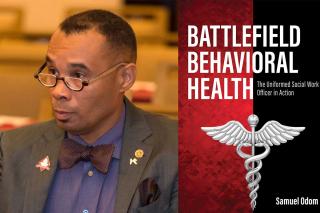
“This is a story that the US Army never knew,” says Professor of Practice in the School of Social Work (SSW), Fellow at the Simmons Institute for Inclusive Leadership, and US Army veteran Samuel Odom, referring to his new book, Battlefield Behavioral Health: The Uniformed Social Work Officer in Action (Cognella Press, 2026).
Per the publisher’s website, the book “examines the roles and perspectives of social work officers serving in combat environments.” As Odom explains, “My book sheds light on lived combat experiences of behavioral health officers. Readers will learn about the coping strategies, challenges, and strengths of these individuals.”
Beyond the domain of social work practice, Odom’s study informs readers across academic disciplines and service professions.
“Battlefield Behavioral Health is designed for both undergraduate and graduate students,” Odom says. “It also intersects with the disciplines of social work [research and military], psychiatry, counseling, psychology, and behavioral health, as well as Reserve Officers’ Training Corps [ROTC] programs.”
The Research Process
The research undergirding Battlefield Behavioral Health was approximately a decade in the making. During this period, Odom conducted several interviews with 10 US Army Uniformed Social Work Officers — five men and five women representing different levels of professional experience, including from the rank of Captain to Colonel.
“The research process constituted a qualitative phenomenological study,” Odom explains. “Through this research, we were able to identify coping and self-care strategies and specific roles of uniformed social work officers during various combat operational settings. Understanding the human condition from the lived combat experience of deployed uniformed social work officers is profoundly invaluable.”
In addition to Battlefield Behavioral Health, Odom has edited a forthcoming book with Cognella Press, titled African American Military Social Work: Keys to Surviving Based Upon the Lived Experiences of Black Uniformed Social Work Officers from 1970 to Present.
Simmons SSW Pride
As a director of SSW’s certificate in clinical practice with active service members, veterans, and families, Odom teaches classes that align with Battlefield Behavioral Health. These courses include “Military Social Work Practice: Introduction to Systems, Culture, Health, and Social Issues” (SWO 516) and “Military Social Work Practice: Therapeutic Interventions within Military Cultural Context” (SWO 517).
“In terms of the graduate certificate program’s curriculum, the courses define and frame uniformed and military social work. Understanding military structure, history, and core values of the Armed Forces under the Department of Defense helps students understand how service members, military families, and veterans cope and thrive during and after military service,” Odom notes.
Odom relishes the opportunity to educate aspiring social workers at Simmons University’s historic SSW.
“I take enormous pride in being a faculty member at the first social work school in the nation,” Odom says. “This has been a wonderful experience for me, and I feel that Simmons is an institution and an academic touchstone for the cultivation of learning and teaching that pushes our students to the flaming frontiers of knowledge.”
A Life of Service
As a pracademic and US Army combat veteran, Odom has been drawn to service professions.
“I pursued social work as a graduate discipline for a variety of reasons,” he says. “Social work offers immense opportunities for practitioners and researchers; employment is and remains available in a variety of settings: the US armed forces, hospitals, politics (US Congress and government), and the academy. Also, countless social workers are CEOs and COOs of Fortune 500 or 1,000 companies.”
Serving in the military brought Odom professional and personal experience unmatched.
“Serving in the United States Army as a commissioned officer for more than two and a half decades helped me to become the person I am today,” he says. “More importantly, my overall military experiences enabled me to foster lifelong relationships, friendships, and countless memories during peacetime and combat.”
Reflecting on the advances of the social work profession, Odom says, “I believe that pouring into others by preparing the next generation of leaders is a way to pay it forward. I am unquestionably grateful to be an active member of a profession that has shaped my being as a person while also continuously enabling me to serve others and make a difference for our most vulnerable.”