
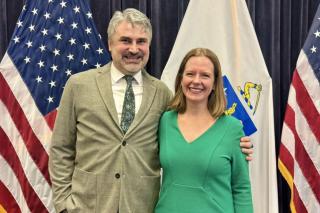
On June 2, School of Social Work (SSW) Professor Kristie A. Thomas and Director of Survivor Advocacy Response & Prevention (SARP) at Boston University Nathan Brewer ’10MSW, ’14C, ’21PhD were sworn into the Massachusetts Governor’s Council to Address Sexual Assault, Domestic Violence, and Human Trafficking.
“I am deeply grateful for the opportunity to effect change with such a variety of distinguished experts and honored to be one of the few researchers on the Council,” says Professor of Social Work and Dean for Academic Affairs Kristie A. Thomas, recently sworn into the Massachusetts Governor’s Council to Address Sexual Assault, Domestic Violence, and Human Trafficking.
The Council’s mission, as its website states, “is to advise the Governor on how to help individuals, children, and families of the Commonwealth live a life free of sexual assault, domestic violence, and human trafficking.”
Nathan Brewer ’10MSW, ’14C, ’21PhD, a former student and now friend and colleague of Thomas who serves as director of Survivor Response & Prevention (SARP) at Boston University, is also a new member of the Council.
“I look forward to the chance to contribute to violence prevention and survivor services all across the Commonwealth,” says Brewer. “It is exciting to work with such a wide array of people, including survivors, practitioners, researchers, and policymakers.”
For Brewer and Thomas, these two-year appointments are recognitions of their research and expertise. Last summer, Brewer presented on campus violence prevention and response before a federal agency and was then invited to present to the Council. Eventually, the Council invited Brewer to co-chair the inaugural Subcommittee on Campus Violence, alongside Alex Nally, deputy general counsel at the Massachusetts Department of Higher Education.
After the Council learned of Thomas’ research on housing instability, she was invited to present her findings. Following a meeting with Stephanie Brown, CEO of Casa Myrna Vasquez (Boston’s largest domestic violence organization), Thomas was asked to serve on the Subcommittee on Housing.
Relevant Research and Practice
Thomas’ subcommittee service draws from her decades of experience as a practitioner and researcher of intimate partner violence (IPV).
“It’s really my life’s work to ultimately eliminate IPV,” she says. “If we can’t get there, at least we can ensure that services, systems, and policies don’t make it harder for survivors.”
Thomas also notes that the Simmons School of Social Work (SSW) has been committed to IPV research and has featured faculty specializing in this topic since the 1980s. Notably, the SSW offers one of the few online (and complimentary) domestic and sexual violence trainings approved by the MA Department of Public Health to fulfill the Chapter 260 legislative mandate.
With a background working in domestic violence shelters, Thomas focuses her research on the intersection of IPV and housing instability. She underscores the importance of the Subcommittee on Housing’s work.
“We are in a dire situation now with all of the changes that have been made by HUD [the US Department of Housing and Urban Development],” she says, noting that HUD plans to substantially decrease funding for permanent housing supports, including permanent housing vouchers, the gold standard in homeless prevention.
“We are on the precipice of a very serious, even catastrophic crisis, in terms of impending homelessness, and it’s urgent that we figure out how to provide housing for survivors in expensive places like the Greater Boston area,” she explains.
Like Thomas, Brewer has worked in the domestic violence shelter system, and now oversees prevention and survivor services for students enrolled in higher education.
Co-chairing a new subcommittee on campus-based violence for the Council, Brewer will identify members, set the mission, and evaluate current needs on college campuses across the Commonwealth. Alongside co-chair Nally, Brewer will advise the implementation of the Campus Sexual Violence Act, signed by former Massachusetts Governor Charlie Baker in 2021.
“We’ll assist schools by providing best practices and known solutions to challenges,” he says.
Brewer also plans to address sexual misconduct climate surveys (used to understand the incidence of different types of violence, knowledge of policies and resources, and perspectives on campus safety), which are complex and challenging.
“That’s one area where I am really interested in applying what I learned at Simmons, and what we know from research in the field,” he notes.
Brewer’s service to the Council overlaps with his role overseeing violence response and prevention at Boston University.
“My role will directly inform the work I do on the Subcommittee, including naming existing challenges and creative solutions,” he says. “I am really excited to bring my experience to the Subcommittee and have discussions with policymakers and the departments that implement the laws.”
Furthermore, Brewer brings to the Council his research on dating violence, particularly among young individuals and college students. “My most recent articles benchmark what services are provided on college campuses across the US,” he adds.
A Holistic Discipline
Both Thomas and Brewer were drawn to social work for its stimulating blend of psychology and sociology. This interdisciplinary framing enabled them to understand the relationship between the individual and their environment.
Thomas wanted a career that would empower her to generate positive change.
“I always knew that I wanted to be a professor and researcher, but I wanted to do that within the values and goals of social work,” she says.
After obtaining an MSW and PhD in social welfare from the University of Pennsylvania, Thomas joined Simmons SSW faculty in 2011.
While working in domestic violence shelters, Brewer became intrigued by “seeing people in the social, political, and historical contexts in which they reside.” He also met social workers, many affiliated with Simmons.
“I was really drawn to that systems lens, the liberation and empowerment approach that social work holds at the foundation of everything that it does,” Brewer recalls. For him, analyzing oppression and privilege is essential to comprehending the dynamics of domestic violence.
“I also think about liberation in terms of how we approach our work, including direct clinical work,” he adds. “It’s an application of those anti-oppression principles, which teaches us to honor the experience of privilege and oppression of the individual in front of us.”
Brewer was attracted to Simmons’ Master of Social Work program for its strong clinical training, long history of clinical work, and grounding in liberation principles. He appreciated that the Social Work PhD program is designed for working professionals, enabling him to maintain his full-time clinical work with survivors.
“Knowing that my work is furthering the safety and well-being of those in our community by preventing violence before it has happened, and easing the burden that survivors bear when it does, is very meaningful to me,” says Brewer.
From Mentorship to Friendship
Brewer met Thomas the year before he applied to Simmons School of Social Work.
“Getting to meet Kristie and see what an amazing researcher she is was pivotal for me,” he recalls. “At the time, she was one of the few folks in the country researching domestic violence in LGBTQ relationships, an interest that I share.”
Upon first meeting, Thomas recalls Brewer being “full of energy.” He came to meetings equipped with elaborate charts, concept maps, and other visuals, which impressed her.
“We hit it off right away,” Brewer recalls. “We have shared values and research interests, and we also share identities, such as being first-generation college students, and our sense of humor and work ethic are similar.”
As a graduate student, Brewer appreciated Thomas’s balanced teaching style.
“Kristie challenged me and wanted me to grow and stretch. And she was able to do all of that with warmth, grace, and humor,” he says. “It was important not just when I was a student, but it also modeled how I approach mentoring in my current role.” Brewer now supervises advanced Simmons MSW student interns at SARP.
“I always see the SSW PhD students as my colleagues,” says Thomas. “Our students, including Nathan, come in with a deep expertise in social work practice. They can do things that I absolutely cannot do, and they are coming to me to learn the things that they cannot yet do. Inevitably, it is reciprocal learning.”
Over the years, Brewer and Thomas have collaborated by co-authoring research papers and co-teaching SSW courses. They also connect with one another socially.
Building Relationships
Speaking about the rewards of her field, Thomas reflects on being “a bridge between research and practice.”
For instance, she explains, “In the classroom, I enjoy helping students connect their own practice to research, and vice versa. I’m very relational. I love connecting people to each other, especially when they have a common goal, like survivor safety.”
Like Thomas, Brewer enjoys the opportunity to build relationships.
“Academia can sometimes separate people into silos, but our field doesn’t allow that,” he says. “We are built on relationships and community.”