

Simmons Reunion 2026 featured a panel discussion about the first-ever Master of Science in Management: Business and Leadership in Women’s Sports concentration, with Professor of Practice Justine Pouravelis, Director of Athletics & Recreation Erica Schuling ’13MS, ’18MEd, and Simmons athlete and finance major Lauren Krupnikoff ’27.
Finding a Niche in Women’s Sports Education
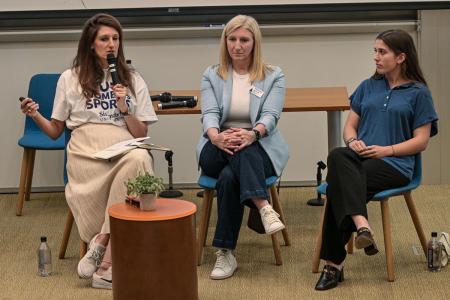
In her introduction to the panel discussion, “Advancing Women’s Sports Business through Simmons University’s Legacy,” School of Management (SOM) Dean Astrid Sheil offered the initial inspiration that led Simmons to offer the first-ever master’s degree focusing on the business and leadership of women’s sports.
Sheil recalled asking Krupnikoff, a current student-athlete, about her studies.
“What she really wanted was to get a minor in sports management,” said Sheil. “She [and a classmate] had taken a course at Emmanuel [College], but everything they discussed was about the men’s teams, nothing about the women’s teams. I thought, there’s our first data point, right there … I saw an incredible opportunity for us to get into the women’s sports sphere.”
In addition, Sheil saw that Simmons had a robust history in terms of athletics, led by Schuling. Athletes also tend to be exceptional students with high retention rates, and the university was looking for more ways to recruit them.
After searching for other programs focused on the business of women’s sports, Sheil realized that the Simmons program would be the first.
Recruiting Pouravelis to Lead the Program
“When I decided that we were going to do this, we looked for faculty to teach sports management,” said Sheil. While she received applications from traditional, experienced faculty members, Pouravelis (then at the New England Sports Network [NESN]) was an immediate standout. “We talked about women’s teams, the valuation, where it’s growing. It was exciting.”
Pouravelis had been at NESN for 17 years and wanted her next step to focus on women’s sports. “What I didn’t realize,” Sheil said, “is that I had hired a complete rolodex. Justine knows everybody in this town.”
Growth and Opportunity in Women’s Sports
Pouravelis then offered some perspective on the industry, noting that Deloitte predicts that women’s elite sports will generate at least $3 billion in global revenue this year.
“Simmons wanted to be the first one to do it, the only one studying the professional women’s sports scene,” said Pouravelis. The goal was to begin with a cohort of 15 this fall, but 20 students have enrolled, including a student who has already played in professional league sports.
Schuling also noted how Simmons has enhanced the opportunities for student athletes.
“Since 2006, I’ve been part of Simmons Athletics full time,” said Schuling. “At the time, soccer was the only team doing off-season training. Now all of the teams train year-round.” Facilities have also improved since the opening of Daly Field in 2016.
A Student Perspective
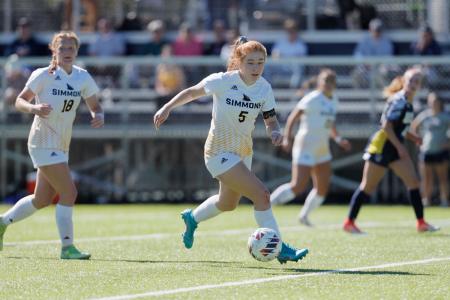
Krupnikoff came to Simmons for the opportunity to play soccer and lacrosse. She was chosen to represent the Great Northeast Athletic Conference (GNAC) on the NCAA Division III National Student-Athlete Advisory Committee (SAAC).
“It’s great to see the specific lens [of women’s sports] at Simmons, in combination with hands-on work in the Boston and greater Boston area,” she said.
As part of her “Intro to Women's Sports Management” (BUS 121), Krupnikoff’s class toured NESN production trucks and attended a Red Sox game at Fenway. As part of a semester-long project for the course, the students developed a marketing plan for a women’s sport event, including a social media content piece. Krupnikoff’s piece focused on five soccer players at women’s colleges.
“Finding that women-centered community in management classes is great as well,” she said.
Program Design and Boston’s Role
For Pouravelis, the program is modeled on professional athletics.
“Women’s teams and athletes, that’s our lens. We talk about the men’s teams as a comparison point: what makes the fanbase different, how emerging teams are growing, how they may launch, how they may save costs and grow,” she said. “The WNBA is a big business at this point, and our program aligns with that ecosystem.”
In addition, Boston is a hub for both higher education and professional women’s sports, with the Boston Fleet, Boston Guard, Boston Banshees, Boston Legacy FC, and Boston WPBL.
Schuling, who played Division I sports in college, is proud of Simmons students and the equal attention paid to athletics and academics.
“I’m so proud of our 11 teams,” said Schuling. “We’ve recruited nationally, across 20 states, bringing top athletes to campus.” There will also be a student working with the athletic department in the fall, an important recruiting offer.
In addition, the new Living and Learning Center (LLC) will offer top-notch training facilities for student athletes. A competition-size swimming pool, diving pit, and a diving trampoline will also attract area athletes to use our facilities. There will be fitness areas for cardiovascular and strength training, a varsity weight room for Simmons athletes, and a sports medicine clinic. The rowing tank on the third level will be equipped with bodies of water, so that rowers can practice rowing against a natural current.
“Students, faculty, and staff will have the opportunity to use the building’s [amenities],” said Schuling, “and alumnae/i will have the chance to purchase day passes or memberships.”
Media Recognition and Outreach
Pouravelis also emphasized the media attention the program has received thus far — all of it “earned coverage,” as opposed to a big marketing push. The program has been featured in The Boston Globe, The Business Case for Women’s Sports (podcast), Sports Business Journal, Togethxr, Boston Business Journal, WBZ News radio 1030, and different social media channels.
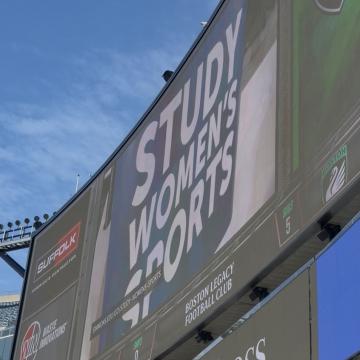
One of Dean Sheil’s media spots was shown at a Boston Legacy game earlier this year. Simmons launched a campaign to promote the program with T-shirts that read "Study Women's Sports."
Since the initial launch, Simmons has introduced the Business and Leadership in Women’s Sports Advisory Board, and more recently, the faculty for the Women in Sports concentration. Pouravelis sees the undergraduate minor as a potential feeder directly into the master’s program.
“We want to bring alumnae/i into the program,” said Pouravelis. “Be an ambassador, tell people, tell your neighbors. Are you good at marketing? Do you know of an event space? Connect us with folks. We will have more opportunities to volunteer or support the program, including launching a fund and growing women’s sports case studies and research, in order to build the most robust program we can.”
Women Sports and the Next Generation of Leaders
Sheil noted that, according to Deloitte, 95% of women CEOs in the US played college athletics.
“The women who graduate from Simmons go on to do important things,” she said. “This college is needed more now than ever before. Women’s voices are needed at every level. We are setting women up to be successful in business, and in any career.”
Pouravelis noted that an alumna from the Class of 1970 recently attended an information session about the program, and has submitted a non-degree application.
“She said, ‘I love sports, and this makes me so happy. We didn’t have anything like this when I was at Simmons,’” she said.