
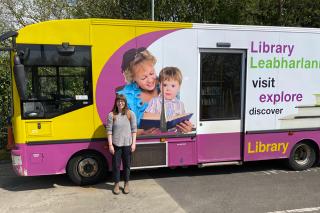
While at Simmons, Danielle Dempsey ’24MS began an international librarianship research project on libraries in Ireland. The resulting article, “Ireland’s Cross-border Mobile Library Service: Two Decades on the Road (2004–24),” was published in Library Information & History (volume 42, issue 1, April 2026). Dempsey shared with us the experience of visiting Ireland and speaking to locals about the area’s fraught history.
Danielle Dempsey ’24MS began her online Master of Library and Information Science (MS) degree, taking advantage of the opportunity to “design your own program.”
“I wasn’t 100% sure of what I wanted to do, so I took a bit of cultural heritage, history of the book, and anything else that interested me,” she says. During her studies, the Library and Information Science: Libraries and Librarianship concentration was unveiled, and Dempsey enrolled retroactively, having nearly completed the track on her own.
“Doing the degree while working full time was a lot, but being able to apply things to my actual job in real time is probably the reason why I did that program,” she says. “I work at a university library, handling acquisitions, electronic resources, cataloging, usage, and collection development. I like the variety that it offers every day. I can do a little bit of everything I studied in my job.”
The first seeds of the research project that would inspire her to take two trips to Ireland and result in her first publication were planted in summer 2022, when she took “International and Comparative Librarianship” (LIS 490) with Professor Lisa Hussey.
“Every student in the class chose a country to focus on throughout the semester and for our final project. Mine was Ireland,” she says. “There was no way to do the project without diving into the country’s history of colonialism and how that impacts a government library system. Also, there is a history of suppression of the native language in Ireland. All of these things feel very tied together.”
When she continued the project after the semester was done, Dempsey recalls, “Professor Hussey suggested an independent study may be a place to channel the research.”
Firsthand Research in Ireland
Dempsey notes that Professor Hussey offered valuable support during the planning and research phases of the project.
“We would have these calls to talk about the research, between the class and the independent study,” she recalls. “I really like a structured plan and an outline, and I tried to schedule every minute of that first trip. Professor Hussey encouraged me to leave space for discovery, both in visiting and in writing. I journaled each day of the trip, and that’s where I found the more niche topics that I kept returning to — including the mobile library.”
That year, Dempsey applied for a McGrath Global Research Grant, which she was awarded in early 2023. That funded her first visit to Ireland in late April through early May, when she attended the cross-border joint conference of the Library Association of Ireland (LAI) and the Chartered Institute of Library and Information Professionals (CILIP).
“The organizations alternate which side of the border they meet on every year,” says Dempsey, who attended in 2023 and 2024. “That was a great way to start meeting people. I also spent a few days researching at the Linen Hall Library in Belfast and the National Library of Ireland and Dublin City Archive.”
An independent library, Linen Hall isn’t affiliated with the government. This helped the library attain legendary status during the Northern Ireland conflict — often referred to as “the Troubles” — which divided the country from the late 1960s until the Good Friday Agreement in 1998.
“There’s a story about the head of the library going out when the fighting was beginning and gathering flyers and ephemera from both sides of the conflict,” she says. The library has a wide array of items, many of them donated by people along the border: local election posters and political buttons, as well as crafts that citizens created during forced internment.
“It’s a wide array of conflict-related materials from all perspectives and all religious backgrounds,” notes Dempsey. “It’s unique that an institution would be trusted by both sides of the divide. It’s the best place to go to research the Troubles, and I was lucky to talk to a lot of librarians who worked there.”
The preparation she did before the trip was also key to her success.
“I did a lot of reading about the area’s history,” says Dempsey. “It was a short trip, and I needed to know the basics to make good use of the time and gain people’s trust.” She consumed a wide array of media: books, documentaries, and podcasts.
Also, Dempsey wasn’t sure how locals would respond to her questions. “I was scared no one would want to talk to me. Why should they? I’m young and an American. How do I approach questions about the conflict?” She knew getting a firsthand account would be valuable, regardless of what she learned.
“If somebody was going to tell me a story and say something I thought I already knew from books, I would be happy to listen and learn from their perspective,” she says. “I tried to leave a lot of space for whatever stories people wanted to tell.”
Shadowing the Mobile Librarian
The mobile library started after the Good Friday Agreement, with funding for PEACE Programs from the European Union.
“It was only funded for three years, and it’s still running," Dempsey says. "That means the jurisdictions on either side of the border saw value in it and agreed to fund it jointly all this time. It has lasted through the COVID-19 pandemic and questions of how Brexit would impact movement across the border.”
Dempsey took the train from Belfast to Derry to shadow the cross-border mobile librarian, Denis Doherty, on the route he had been traveling for nearly 20 years. Much of her resulting article was based on his oral history.
“He had spent all of his life in Derry before moving to Donegal, and had lived through the conflict,” says Dempsey. “He had seen the border evolve over time. When we drove across it, he would ask me, ‘Can you tell where it used to be?’ I couldn’t, but he knew.”
Doherty’s alliance, however, was to the service he provided. “He approached every person at every stop along the mobile route the same way, and they all greeted him with the same excitement … it was an effective service, equally dedicated to everyone.” His early aspirations to work in the United Nations seemed, to Dempsey, in line with his work for the mobile library.
Every stop for the mobile library is scheduled and alternates every two to three weeks. The stops are chosen based on rurality along the border, and they also try to visit schools where there is no school library. The interior of the mobile contains U-shaped shelves, with a section in the back for children’s books.
“It’s like an event,” Dempsey says. “Families and friends will walk down to where the mobile library is going to stop.” Every aspect of the mobile library is community-focused, as are its patrons. Dempsey saw patrons picking up books on behalf of their book club or loved ones. “They would say, ‘I’m getting this for myself and this for my sibling.’”
Dempsey returned for the LAI/CILIP conference in 2024, thanks to professional development funding from her employer, Villanova University, and her own funding.
“I was very invested,” she says. “I was able to be there for the mobile librarian’s last full week of work, before stepping down to part-time as the start of a flexible retirement.”
She also visited the Shantallow Library, the local branch library in Derry, which the mobile library uses as a home base. “They keep the stock and holds, and Denis has a desk,” she says. “I talked to the staff there, who were involved in the branch and the home delivery service.”
While there, Dempsey was amazed by how well Doherty knew his patrons. “He picked out five westerns, off the top of his head, for this one patron. He said, ‘I don’t think he’s read any of these,’ and he was right. He did that for a lot of people.”
Dempsey is grateful for the experience of traveling abroad for this research and emphasized her thanks to Simmons and Villanova for their support. “Being able to travel, to research and have conversations in person, made the paper possible.” She’s already dreaming of returning to Linen Hall to research her next idea.