
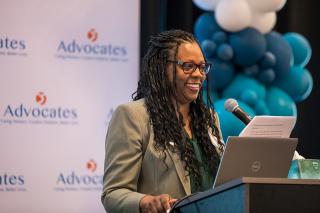
Regina Marshall '98 has spent her career advocating for people with disabilities, shaping public policy, and expanding access to care. Now, as Chief Executive Officer of Advocates, Inc., one of Massachusetts' largest providers of behavioral health and human services, she's leading an organization whose mission reflects the work she's devoted her life to.
For Marshall, the path to executive leadership began long before law school or state government. It started with a single visit to Simmons.
“I had no interest in going to a women’s college,” she says. Then she stepped onto campus.
“I can’t even describe the feeling,” she recalls. “I felt like it was where I needed to be.”
Looking back nearly three decades later, Marshall sees Simmons as the place where she discovered her confidence, her voice, and the type of leader she would become.
“I was quiet in high school. I wasn’t someone who made a big splash,” she says. “But at Simmons, I felt so comfortable. I could be the leader I wanted to be, and it launched me into the rest of my career.”
Discovering a Leader
Leadership quickly became central to Marshall’s Simmons experience. She served as class president all four years and went on to lead the Student Government Association (SGA) during her junior and senior years. Those roles brought her into regular conversations with University leadership, including then-President Daniel Cheever.
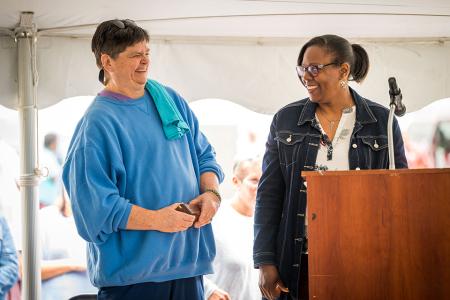
“I got to meet with the president and attend board meetings,” she says. “It really opened doors for me and helped me become comfortable in leadership spaces.”
Marshall credits faculty and staff members Cheryl Welch, Professor Emeritus of Political Science and International Relations; Sheila Murphy, former Dean for Student Life; and Sarah Neill, former Director of Student Life Administration, with encouraging her growth. As a political science major, Marshall explored politics, diversity, and women's leadership while putting those lessons into practice through student government.
One particular moment during her time as SGA president proved foundational.
SGA officers received stipends for their work. When evaluating the team, Marshall faced a difficult scenario: one student had enjoyed the perks of the role without contributing to the work. The decision of whether to award the stipend rested entirely on Marshall’s shoulders.
“It was really hard as a 20-year-old to make a decision like that,” she said.
Ultimately, Marshall chose not to award the stipend. Years later, when the two reconnected, her former classmate offered an unexpected reflection.
“She told me it had been a key learning moment for her,” Marshall said. “As angry as she was at the time, she respected that I held her accountable.”
That experience became a cornerstone of Marshall’s leadership philosophy.
“It taught me that you can hold people accountable without being disrespectful. I try to encourage people, support them, listen, and make sure they’re in the right roles. But when hard decisions need to be made, you have to make them.”
A Career Built on Advocacy
Though Marshall entered Northeastern University School of Law planning to practice corporate law, a poverty law clinic redirected her trajectory.
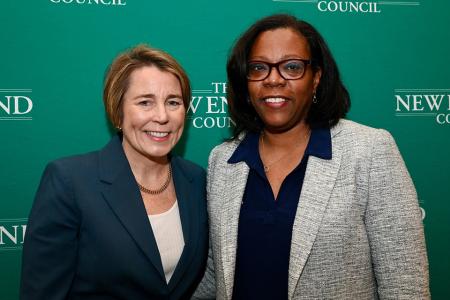
“I realized I could use all this knowledge to actually help people,” she says. “I didn’t want to just make rich people richer.”
Marshall began her career advocating for individuals with disabilities before stepping into senior leadership roles with the Massachusetts Department of Mental Health, the Executive Office of Health and Human Services, and Mass Mental Health Center. Each position deepened her understanding of how policy, funding, and direct services intersect across the Commonwealth.
“When I was working as a legal advocate, we could help the people who found us,” she says. “But I always wondered about all the people who didn’t know to ask for help.”
Now, as CEO of Framingham-based Advocates, Inc., Marshall is shaping those systems on a broad scale. The organization provides behavioral health, developmental disability, brain injury, substance-use recovery, and community-based services to thousands of individuals and families across Massachusetts.
“I can help set the direction for how care is delivered,” she says. “That’s where I wanted to make an impact.”
Representation and Leadership
Growing up in Westfield, Massachusetts, Marshall was often the only Black student in her classroom. Years later, while leading a local Girl Scout troop, she saw the power of representation in action.
When she first asked the girls what they hoped to become, many named familiar, local roles. After Marshall introduced them to women of color working as attorneys, scientists, and executives, their perspectives expanded.
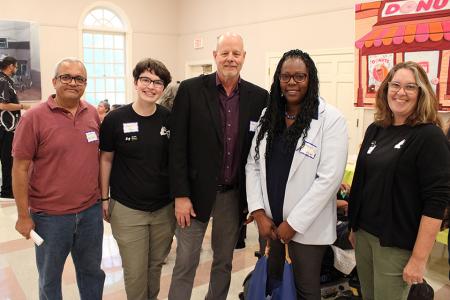
“By the end, they were saying, doctor, lawyer, astronaut,” she says. “Seeing someone who looks like you do something changes your whole sense of what’s possible.”
As one of the few Black women leading a major human services organization in Massachusetts, Marshall brings that same awareness to her current role.
“When staff tell me, ‘You look like me, and you’re in this role,’ it creates genuine excitement about what’s possible for their own careers,” she says. “That’s the piece that energizes me every day.”
Leading by Listening
Advocates, Inc. operates on a central principle: First we listen. It’s a philosophy that mirrors Marshall’s approach to both management and community care.
“I’ve always liked to listen almost as much as I like to talk,” she says. “You can’t truly help someone until you understand their experience.”
Whether supporting employees or guiding services for vulnerable populations, she grounds her work in mutual respect.
“Even in our most vulnerable states, we are still the experts on our own needs,” she says.
Connecting Back to Simmons
Marshall encourages current Simmons students to embrace every opportunity to discover their strengths and find where they can drive meaningful change.
“Take the time at Simmons to learn who you are and gain your voice,” she says. “There are so many opportunities in the nonprofit and public sectors to use your degree for good and support communities in ways you might not yet imagine.”
Decades after her graduation, Marshall’s ties to the University remain strong. She is eager to engage with current students as a mentor and speaker.
“I loved my Simmons experience,” she reflects.
For Marshall, Simmons wasn’t just where she earned her degree — it was where she built the confidence to lead, setting in motion a career that continues to strengthen communities across Massachusetts.