
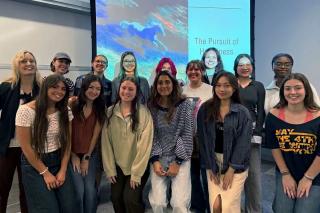
Associate Professor of Psychology Geoff Turner had a practical reason for creating a course, “And the Pursuit of Happiness” (PSYC 217) at Simmons.
“From a cognitive psychology perspective, people are really bad at understanding their own mental processes," says Turner. “They spend a lot of time working on things that don’t actually make them happy.”
As then-faculty senate president in 2019, Turner was tasked with addressing first-year students at Convocation. He became aware, around that time, of a pervasive unhappiness in the incoming classes.
“These students are very accomplished and work very hard, but a lot of them don’t know what they’re working for,” he says.
He found himself offering advice to boost their happiness, such as unplugging from social media and screens.
Not long after this, when Yale professor Laurie Santos became a media celebrity for her course, “Psychology and the Good Life,” Turner reached out to her for inspiration to create a course in happiness at Simmons, which he developed during the COVID lockdown in 2020. Per the description, the course aims “to help you use scientifically derived knowledge on happiness to understand how you can become happier.”
The Cost of Happiness
The course is being taught this semester by Sarah Rose Cavanagh, senior associate director for teaching and learning at the Center for Faculty Excellence and associate professor of practice in the psychology department.
Cavanagh has also included a critical examination of current societal trends.
“There are many people profiting off the idea that people want to be happy,” she notes. Over the past 10 years, she’s noticed that a dismaying amount of the research on happiness is funded by companies selling apps that purport to increase happiness in a variety of ways.
This shift worries Cavanagh. “The profit motive is not going to drive authentic research,” she says, “they want research outcomes that will serve their bottom lines.”
This structure also puts the weight of one’s happiness on the individual: if you download the mindfulness app and track your emotions on your phone, then surely you will achieve greater happiness. At least, that’s what the apps constantly “checking in” through push notifications and daily alerts want us to believe.
“What will actually boost happiness is greater income equality, well-funded education, and a more balanced life without burning ourselves out,” says Cavanagh, who encourages students to critically examine the power structures behind the current wellness industry. “If citizens think that their happiness is their own responsibility, they may be less likely to fight for the sorts of changes that would actually make us happier.”
Advocating for social justice may not afford immediate happiness, but it offers a necessary groundwork of stability for more people to achieve “self-actualization,” the pinnacle of Maslow’s hierarchy of needs.
Online Worlds and Isolation
The course also pairs well with Cavanagh’s current research in happiness, which tackles the paradox that despite the increased security of modern life, people are trending unhappier.
Cavanagh’s next book has identified happy individuals around the world — on nude beaches, in nunneries, at festivals — and offers their unique perspectives.
“Each happy person I’ve found is resisting the push toward more technology and greater isolation,” Cavanagh notes, “instead embracing what makes us human. Namely, sleep, social connection, sex, time in nature, experiences that are psychologically rich, and pursuing a purpose greater than ourselves.”
In her book Hivemind (Grand Central Publishing, 2019), Cavanagh shares the impact of social media on modern psychology. Online interaction can enhance social connections for the good, but too much focus on these online relationships can eclipse real-life connections when we spend too much time staring at our phones.
However, the online landscape has changed significantly since that book was published. Cavanagh cites a paper by dana boyd, “Social Media is Now Parasocial Media,” as social media feeds are now flooded with influencers and advertisements rather than updates from our friends and family. While many people are leaving social media platforms, that makes the trend more dangerous for those who remain, with algorithms offering polarized political content, filtered faces, and “looksmaxxing.”
Add to this technology landscape: AI chatbots. In particular, young people turning to AI for mental health support and companionship will not find the kind of support they need, given the nature of a predictive language model that agrees with whatever the user says, lacking any actual consciousness. Cavanagh recommends an episode of NPR’s Life Kit series detailing the impact of AI chatbots on a teen’s mental health.
“AI can’t effectively replace human connection,” says Cavanagh, who cites another recent study where a chatbot trained in all the insights of relationship science had less of a positive impact on student well-being than conversing with a randomly chosen fellow first-year student.
“People don’t appreciate the impact of social interactions, even interacting with strangers,” adds Turner.
Why It’s So Hard to Make Healthy Choices
“Young adults are free for the first time in their lives, and bound to make mistakes,” notes Cavanagh. “My students know that they need to get more sleep; they know that they shouldn’t be on their phones until 2 in the morning. They are busy with work and assignments, and often feel like they haven’t had any time to themselves all day.”
The result? Something called “revenge bedtime procrastination,” where we feel like we’re owed downtime at the end of the day, even at the expense of our own health and well-being.
It’s worth noting that apps like YouTube and TikTok have designed their algorithms to make them as addictive as possible. “It’s not a fair fight,” says Cavanagh.
Turner notes that evolutionary instincts are also working against us. “Humans were built by evolution to be hedonic: to opt for immediate pleasure at the expense of long-term happiness. This has been a successful evolutionary strategy for our species, to prefer instant gratification and what feels good in the moment.”
What if students are looking for a quick boost to their happiness?
“Sleep comes first,” says Cavanagh. “It’s hardest to delay gratification and control impulses when you are not well rested. If you sleep well, you have the energy to regulate your emotions and make better decisions. I prioritize sleep over a lot of other things.”
Cavanagh is always looking for new ways to present what research has already shown: the importance of time in nature, exercise, and regular social interactions, in addition to sleep. To keep students engaged, she encourages them to puzzle these factors into their own lives. “We know this is good for us, but how do we make time for it?”
Turner also tries to emphasize the need for sleep to his students and notes that better sleep has been shown to increase students’ GPA, decrease feelings of anxiety and depression, and improve focus and concentration.
He also recommends that everyone write and send a gratitude letter to someone who has made a difference in their lives, which he assigned to the students in his Happiness course.
“I was struck by the students’ reaction to writing the letters. There was not a dry eye in the classroom when students shared their experiences,” says Turner. “It has been one of the most beautiful class experiences of my over 30-year teaching career.”
Students looking for happiness-boosting connections can check out upcoming on campus events.