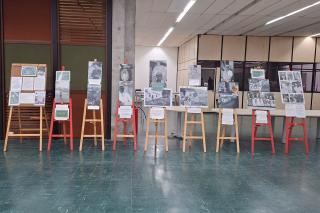
Exhibition, "In the City of Women: Ruth Landes' photo collection of Brazilian Candomblé, 1938–1939" curated by Dr. Jamie Lee Andreson, at the main library of the Federal Univ. of Bahia as part of the Brazilian Studies Association meeting in July 2026.
“I also enjoy asking difficult questions about the present. And I think that looking at the past helps me understand the world today, and the structures that I am a part of,” she adds. “I am inspired to teach students and prompt them to think about their place in the world, and how they may shape the future.”
Andreson’s precise research specialization is in the cultural history of Brazil from the nineteenth century to the present. She was initially drawn to this area because it was underrepresented in her earlier education and in the US media.
As an undergraduate at the University of California, Berkeley, she began conducting comparative research on Brazil and the US.
“There’s a lot of interesting overlap between the formation of Brazil and the United States,” Andreson says. “And if we are thinking hemispherically about the Americas, in terms of colonization, Indigenous genocide, and the African slave trade, you can draw so many connections and comparisons between those two countries.”
Religious Matriarchy
Broadly construed, Andreson’s research explores women’s roles in the Afro-Brazilian religion Candomblé. Similar to Cuban Santería or Haitian Vodou, Candomblé incorporates West and Central African religious elements.
In Brazil, “the religion is led by families, and the priestesses — the Mothers — are the heads of the families. They create communities, both through blood relatives and a ritual family made through initiation into the religion,” Andreson explains.
Andreson’s first book, Ruth Landes e a Cidade das Mulheres: uma releitura da antropologia do candomblé (Editora UFBA, 2019)/Ruth Landes and the City of Women: A Rereading of the Anthropology of Candomblé, is published in Portuguese and builds upon her earlier comparative work, as well as the history of anthropology. The book is focused on Ruth Landes, an anthropologist who, in the 1930s, proposed that Candomblé is a matriarchy.
“This really brought together my interests in women’s history, the history of race, and cultural history through a study of religion,” Andreson says, noting that her book includes Portuguese translations of archival material held in US collections. “I was able to make that material accessible to Brazilian readers. Ultimately, I saw this first book as a repatriation effort.”
Andreson’s second book, Divine Femininities: Matriarchy and African Heritage in Brazil (currently under review), situates Candomblé within the politics of cultural heritage. Here, she highlights the leadership of Black women within religious communities and examines how they have articulated matriarchal principles in the public sphere through the participation of a multiracial democracy.
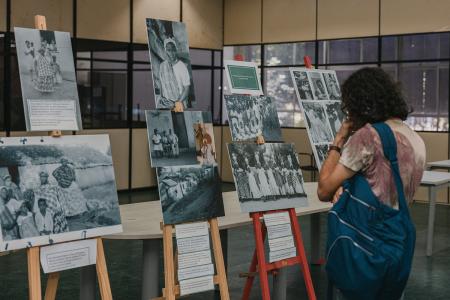
Conference participant viewing the exhibition "In the City of Women" during the BRASA conference at UFBA, Salvador, Brazil, July 2026.
This past summer, Andreson took a photo exhibition she curated, “In the City of Women: Ruth Landes’ Photo Collection of Brazilian Candomblé, 1938–1939,” to the Brazilian Studies Association (BRASA) meeting in Salvador, Brazil, after previously showing the exhibition at Queens College as part of her postdoctoral scholarship with the CUNY Graduate Center.
Following the exhibition, Andreson organized a public tour of the Mãe Menininha Memorial in association with the Terreiro Gantois, a Candomblé temple, where many of the photographs were taken by the U.S. anthropologist Ruth Landes in 1938. To complete the project, which began with her first book in Brazil, she repatriated the archival reprints to the Memorial as a donation to their already robust historical collection.
Multidisciplinary Methodologies
In addition to being a historian, Andreson works ethnographically, meaning she engages with present-day communities and religious practice.
“Being present at ceremonies and witnessing rituals has given me a better understanding of Candomblé,” she says. “I have to use many interdisciplinary methods to be able to understand the complexities of this history, practice, and politics. The elders in the community are the living history, and they have the greatest power, respect, and knowledge. I have learned so much from the matriarchs and their families, especially the granddaughters.”
During her master’s program at the Federal University of Bahia (Universidade Federal da Bahia), Andreson sharpened her language skills and began expanding her disciplinary boundaries.
“Being able to contribute to dialogues and initiatives related to what I was studying was so meaningful, and it gave me an important perspective,” she recalls. “I got to listen to scholars and activists from the place I was studying. Having those frank conversations allowed me to do interviews and do ethnography, and, eventually, public scholarship projects.”
Given that there are not many written sources about Candomblé, which has also suffered state persecution, creating her own archive has been valuable.
“While I myself am not an initiate — there are still things that I do not know and there were very clear boundaries about what I had access to as a foreigner and someone who is not a religious practitioner — I was able to observe religious activity and create oral histories,” Andreson says.
Teaching History at Simmons
Currently, Andreson is teaching a graduate-level course, “Insurgency and Revolution in Latin America and the Caribbean” (HIST 582), at Simmons. The course mainly focuses on the twentieth century, and incorporates written materials as well as iconography, propaganda, videos, and songs.
“There seems to be a lot of interest in this topic, and it brings Simmons students into the field of Latin American history,” Andreson says. “It’s a relatively recent history that shapes our world and global politics in ways that make an impact on students.”
As a scholar of women’s empowerment, Andreson appreciates Simmons’ women-centered learning environment. “I like that Simmons students are interested in studying and questioning gender, and I know that my materials will always be met with enthusiasm and interest,” she says.
“Simmons’ graduate students are often well-connected to archives and museums locally,” Anderson says. “Since I am from the West Coast and recently moved to Boston, I appreciate New England’s love of history, and I learn more about US history from my students.”
Rewards of the Profession
For Andreson, the most rewarding aspect of her career is “being an active and involved researcher.” Enacting repatriation efforts and public scholarship projects has a real impact on the communities she studies.
She also loves inspiring students through teaching and mentoring their research projects. “I can bring to them methods, perspectives, lenses, and questions that make them think a little bit differently,” she adds.
As to words of advice for aspiring historians, Andreson emphasizes “read, read, read, and write, write, write.” She continues, “Right now there are a lot of tools that are telling you that you don’t need to write on your own. My biggest advice is to curate and nurture your own unique voice and perspective, because that is what is going to make you really stand out.”
Andreson also advises students to speak up. “Use your voice. Practice sharing your ideas, being a part of difficult conversations, and contributing to productive debates. It takes bravery and courage to put yourself out there. Put your name to new ideas, which will help you produce new knowledge.”