
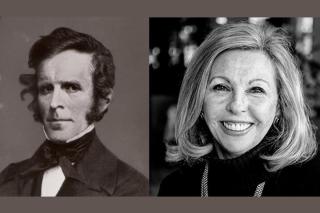
The Office of Advancement hosted a “Storytelling Thursday” in honor of Founder’s Week. During this event, University Archivist Kelsey Kolbet ’21MA/MS engaged in a virtual conversation with author Denise Doherty Pappas ’71, ’85MBA, HT on October 29.
“It’s a major pleasure for me to talk about John Simmons,” began Pappas, author of John Simmons: The Measure of a Man (No Small Matters Press, 2014).
Finding Inspiration
Kolbet first asked Pappas what inspired her to write a biography of John Simmons.
“First of all, I really loved my college experience,” Pappas said. “It was just fabulous. But I really did not fully appreciate it until afterward, once I grew older.”
Pappas recounted that she and her husband lived in Saudi Arabia in the late 1980s. “I lived in a society — particularly at that time, when women had absolutely no rights,” she said. “It was almost unreal, compared to the life I had at home and the education I had. And that’s one of the things that drew me to appreciate Simmons and the life I lived in the United States.”
Moreover, while at Simmons, Pappas befriended Betsy McCandless ’71. In 1992, McCandless was murdered by her ex-husband.
“I cannot begin to tell you how heartbroken we all were, and a bunch of us from Simmons got together and said, ‘What can we do?’” Working with Betsy’s brother, Steve McCandless, they formed Betsy’s Friends in 1994, a peer prevention program about relationship violence.
“It was absolutely the first of its kind in the entire country,” Pappas noted. “It has a 32-year history of something that’s really important to me and important to society, and this is an example of what Simmons does best.”
All of these experiences brought her back to her experience at Simmons, and thinking about what the school, and its founder, represent.
When Pappas began researching John Simmons, former University Archivist Jason Wood ’01MS, ’11MS connected Pappas to one of the first sources she consulted, Delayed by Fire: Being the Early History of Simmons College (1945, reprinted in 2018 by Forgotten Books), by the late Professor Emeritus of Chemistry Kenneth Lamartine Mark. It only contains one chapter on John Simmons.
Curious to know more, Pappas did a fellowship through the Normal Mailers Writing Colony, then in Provincetown, Massachusetts. She studied biography writing and met an instructor at Occidental College who became a dear friend.
“So, that’s how the book came about. It was loving the College and then wanting to share the good news about John Simmons’ life.”
The Storytelling Process
Kolbet next asked Pappas to walk the audience through her storytelling process.
Pappas, who majored in English and history as an undergraduate, credited Simmons professors for instilling important lessons about storytelling. When pursuing her MBA at Simmons, she also learned instrumental skills from her market research courses.
“They taught you to stand up. Speak up … And when you stood up and you spoke … you also wanted to bring something extra that people would remember when you finished talking,” Pappas said.
A key exercise for Pappas was creating a storytelling board. Using her Simmons marketing class skills, she created a storyboard in the form of a one-page comic documenting key episodes in the life of John Simmons. Friend Eileen Kenneally, who then led a design firm called Kenneally Creative, helped her create this graphic.
“I share this graphic with my teaching groups in memoir writing,” Pappas said. “You can all write your life story. I encourage everybody to write their own memoir.”
The Importance of Testimony
Referencing President Lynn Perry’s Wooten’s recent Alumnae/i Townhall meeting, Kolbet asked Pappas about Wooten’s “five Ts”: time, talent, treasure, testimony, and ties.
“Today, the most important thing for me is testimony,” Pappas said. She recounted a recent hospitalization where she spoke with her nurses about Simmons, who all raved about the School of Nursing.
“So that’s the idea of testimony; it really works,” she added. “Not everyone has the money to donate, but everyone can spread the testimony of how Simmons gave us a wonderful education and what it has done for our lives.”
Reflections on Pride
In response to Kolbet’s question of what John Simmons would think of the University today, “He would be so proud,” Pappas responded. “It’s such a fabulous place. And it still has ties to his life.”
Pappas provided a comparison between John Simmons’ pivoting from ready-made garments and the real estate industry to the School of Management’s pivoting to a Master of Science in management: business and leadership in women’s sports concentration.
“This is such a great pivot, given the incredible women’s sports teams now. He would be incredibly proud.”
Furthermore, Pappas noted that John Simmons would be proud of the scholarships and financial aid many students receive. (He originally envisioned that the College would be tuition-free).
“He would probably be proudest of Betsy’s Friends,” Pappas added, noting that John Simmons rescued one of his own daughters from an abusive marriage. “Simmons is doing such a fabulous job, and he would be beside himself with joy.”
Simmons Family Objects from the Archives
Kolbet offered a presentation on the materials related to John Simmons housed in the Simmons University Archives.
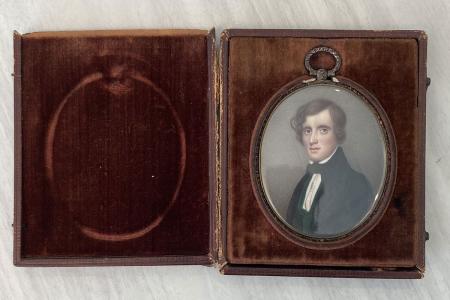
She showed a miniature portrait of a young John Simmons, circa 1840s. “We think that this portrait received the most use after his death. It appears to be a piece of mourning jewelry,” given that there is some hair at the back of the portrait. The object, which is hand-painted on ivory, also reveals his financial success.
After tracing Simmons’ personal, professional, and geographical journey, Kolbet showed some articles of clothing. For example, the archives also has a dress that belonged to John’s wife, Ann Small Simmons.
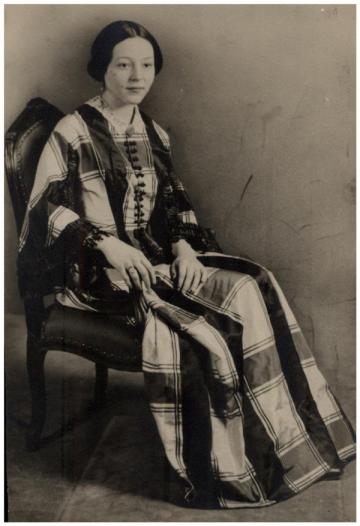
“It is very much a class signifier, due to the fine construction and fine fabrics,” Kolbet says. She also included a photograph of a Class of 1935 student, Bethany Gilcrease, who modeled the dress.
Other objects included a wedding dress of Mary Ann Simmons (which includes beautiful lacework), a silver and porcelain tea set that belonged to the family, a flute that once belonged to John Jr., and a miniature portrait of Anna Simmons White, granddaughter of John Simmons. As Kolbet explained, all of these objects signified the Simmons’ high socioeconomic status.
Finally, Kolbet showed a copy of John Simmons’ will, specifically the excerpt from Article 16, which provides the foundation for what would become Simmons Female College.
“I think this is an incredible sign that he believed that women could do a lot of things. He outlined a very broad range of curriculum. It shows that John knew that women were up to the task,” she said.
By supporting women in obtaining an independent livelihood, John Simmons realized that women did not have to rely on their husbands for income.
“John Simmons realized the transformational capacity of an education,” Kolbet said. “In that sense, it [the University] is pretty revolutionary. And that is something that I am more than thrilled to celebrate.”
“John Simmons had so much courage,” Pappas added. “He was so ahead of his time in supporting women.”
The event concluded with a Q&A between the speakers and virtual attendees.