

To honor the Master of Science in Management: Business and Leadership in Women’s Sports Concentration starting this fall, we spoke to three members of the Simmons Business and Leadership in Women’s Sports Advisory Board about their work and how they hope to support these programs at Simmons.
Sara Toussaint, co-CEO of TMJ women’s soccer agency
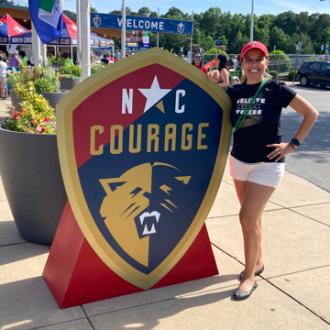
Sara Toussaint is co-CEO of TMJ, one of the first agencies dedicated to representing female athletes. The company represented 20 players in 2017 when Toussaint first collaborated with TMJ, and grew significantly after she transitioned from investor to her current role.
“We now represent over 200 players from all over the world, and anticipate that more than 60 of our clients will play in the FIFA Women’s World Cup next year,” she says.
Toussaint is also a partial owner of the North Carolina Courage team of the National Women’s Soccer League and Querétaro FC of Liga MX.
“Women athletes still have to fight for attention, but their fan base is super loyal and super engaged,” she says.
Toussaint is also excited about the program at Simmons.
“There are a number of sports management graduate-level programs, but none of them are focused on the women’s experience: the players, the fanbase,” she says. “There are so many nuances that come with both groups. Women’s sports is definitely a hot topic and might be on someone’s curriculum, but no other program will offer the foundation that Simmons will.”
Toussaint sees the value in branching out, on and off the field.
“There are studies about FIFA teams indicating that women’s sports teams operating independently see more success.”
For example, a European Premier League’s “sister team” sees a fraction of the attention and funding that the men’s teams get. Meanwhile, clubs focused solely on women, not tied to men’s teams, offer more dedication and focus. She sees a similar dynamic working for Simmons.
“Simmons can build this program from scratch, not constrained by an existing model. We don’t have to do it like the men do it,” she says.
While the sports industry is global, Simmons’ Boston location is yet another asset for Toussaint.
“There aren’t many women-centered academic institutions in the heart of a more fervent sports market than Boston,” she says. “I’ve lived in many sports-focused cities, but Boston sports fans are at another level. Tie a women’s-centered institution to the biggest sports market in the US and it makes a ton of sense. I don’t think anyone can replicate what Simmons just inherently has to offer.”
Toussaint hopes to share what she has learned over 20 years in the industry, from league to team, sports agencies, and ownership.
“I hope I can be a resource, as a woman in this industry, a Latina, and a sports fan in big and small markets,” she says. “I’ve got various perspectives that I hope can inform the curriculum and connect with anyone involved with this program.”
Kassia Davis, founder of KADA clothing brand, executive chairwoman for PF Flyers shoe brand

Kassia Davis has worked in the athletic industry through footwear and apparel, including various roles at New Balance. Although she hasn’t worked directly in sports, she has wanted to get more involved for years.
“Team sports were an important part of what shaped me throughout childhood and high school. I learned teamwork, collaboration, leadership, and resilience at a young age,” says Davis. “So much is changing in women’s sports, and I want to be part of empowering women through sport.”
Being a member of the Simmons University Business and Leadership in Women’s Sports Advisory Board is, she says, “a perfect opportunity to do that.”
“Empowering women through sports also means creating more opportunities for women to lead, innovate, and influence the future of a fast-growing business sector,” says Davis. “I can apply what I’ve learned as an entrepreneur and as a woman working in the corporate athletic industry to what students are learning in the Simmons program.”
Davis has worked across multiple departments at New Balance, which has informed her work as an entrepreneur.
“Working in the corporate world gave me a foundation for understanding the industry and the different processes that are involved in running a business,” says Davis. “Developing leadership skills and the confidence to lead has been vital, and I want to share what I’ve learned. Women are building the foundation for their careers in sports, and this program is a great first step.”
Jennifer Williams, managing principal at global design firm Perkins & Will
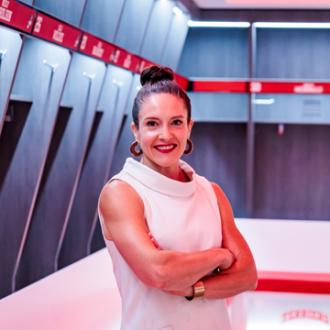
For Jennifer Williams, the connection to sport is personal. She was a collegiate athlete who played field hockey while at design school. When working for an architecture firm after graduation,
“I worked on my first sports building and never looked back,” she recalls. “I went all-in on designing facilities for athletics, recreation, and well-being.”
In her current role as Sports, Recreation, and Entertainment Practice Leader at Perkins & Will, she’s involved in any plan with an athletics element in the Northeast. She leads project work for women's sports nationwide.
“If you’re going to design an athletics facility, you hope that the person designing it knows the nuances of the sport and the daily life of the athlete who will use it, as well as their daily expectations, rules, and regulations,” says Williams.
Considering the financial growth and visibility of the women’s sports industry, Williams sees the timing of the newly launched Master of Management: Business and Leadership in Women’s Sports Concentration and Graduate Certificate in Women's Sports Business as vital.
“There will continue to be opportunities for women in this business, especially as additional teams are added,” says Williams. “Anyone in the program now, learning the professional women’s sports business while the industry is expanding, will be able to gain more insight and be poised for success. Folks coming out of the program will be highly desirable, knowledgeable, and well-connected. There are a lot of amazing people involved in this program.”
Williams is eager to support the industry and share her unique perspective as an expert in sports architecture — a field she hadn’t known existed when she was still in school.
“I don’t work in the business directly, but I can support women through the design of amazing facilities to allow female athletes to perform at their highest level,” she says. “It’s amazing to offer that insight as there’s so much development around purpose-built facilities for these teams, and future opportunities from a design standpoint.”
Williams hopes to share her experience with managing capital projects with students in the program.
“Every sports organization has capital projects of some sort. It’s part of the business and necessary for recruiting and keeping talented athletes,” she says. “I can offer insight about what that process looks like.”