Skip to this page's content

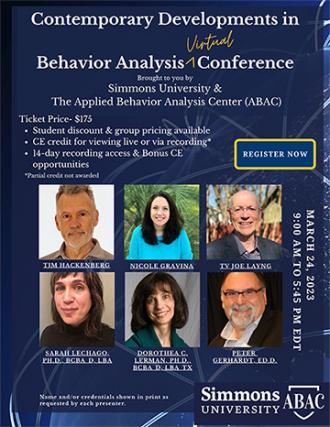
Contemporary Developments in Behavior Analysis

The 3rd Annual Conference on Contemporary Developments in Behavior Analysis is hosted by the Department of Behavior Analysis at Simmons College on Saturday March 12, 2011.

Our annual conference is designed to provide Board Certified Behavior Analysts, Board Certified Assistant Behavior Analysts, and graduate students the opportunity to learn about applied and theoretical issues relevant to their work as behavior analysts. Speakers include leaders in the field of applied behavior analysis and academia. For the 2011 conference, our guest speakers include: Dr. Marc Branch, Dr. Gina Green, and Dr. Charles (Bud) Mace. In addition to presentations from our Simmons faculty, Dr. Ron Allen and Dr. Russell Maguire and doctoral candidates and alumnae.

Simmons College is an Acceptable Continuing Education (ACE) provider and will offer 8 continuing education (CE) units to conference participants for BCBA or BCaCA CEU's.

Presentations:

Evidence-Based Practice: Implications for Behavior Analysts

Gina Green, Ph.D., BCBA-D

Download a slideshow of this presentation

"Evidence-based practice" has become a popular buzz-phrase. Many groups have developed guidelines for treating various conditions that are described as "evidence-based," and that phrase is being used to market many interventions. Some laws and policies even mandate that practices be "evidence-based." This would seem to be a good thing for behavior analysts and consumers of behavior analytic services. But is it? Although "evidence-based practice" originally referred to practices that have proved effective in scientific studies, developers of some practice guidelines have defined "evidence" in a way that excludes most behavior analytic research. The implications of those definitions, the question of why the science of behavior analysis is ignored by so many guidelines developers, and what behavior analysts might do to remedy the situation are the topics of this paper.


Bi-Directional Translational Research: Behavioral Momentum Theory and Treatment Relapse

F. Charles Mace, Ph.D., BCBA-D

Download a slideshow of this presentation

This presentation will provide an overview of behavioral momentum theory with special emphasis of treatment relapse and the factors that lead to it. Three laboratory-derived models of treatment relapse that are inspired by behavioral momentum theory will be presented. The clinical implications of these models will be discussed along with studies illustrating a bi-directional approach to translational research.


Behavior Analytic Approach to Increase Exercise Behavior in Overweight and Obese Adults

Gretchen A. Dittrich, M.A., BCBA

Download a slideshow of this presentation

Behavioral medicine involves the application of behavior analytic principles to the prevention, treatment, and rehabilitation of medical and health disorders. Behavioral medicine evaluates the relation between behavior and biology, and provides methods to shift these relations to improve overall health in individuals, populations, and communities. An issue of interest in the field is ameliorating the obesity epidemic. Currently, 68% of Americans are obese or overweight, and the prevalence is rapidly growing. The current study evaluated a behavior analytic treatment package to increase exercise behavior in overweight and obese adults. The program utilized a variety of empirically validated methods to establish and maintain exercise behavior, which can replace more sedentary behavior. Methods included: self-monitoring, goal setting, correspondence training, social support systems, stimulus control, shaping, and relapse prevention. A variety of independent variables were introduced simultaneously; however, given the complex constellation of variables associated with inactivity, such an approach was necessary. In addition, multiple dependent variables related to exercise were assessed, and measures of improved health were measured directly and demonstrated, rather than assumed by way of indirect measures. Furthermore, data were collected using devices that automatically transmit information electronically, eliminating the inaccuracies related to data collected through self-report. The behavior analytic treatment was effective in increasing exercise duration, frequency, and variety, and decreasing inter-response time between workouts. Furthermore, participants experienced improvements in overall health, and demonstrated increased strength and flexibility.


Behavioral Pharmacology: What it was, is, and might be

Marc Branch, Ph.D.

Download a slideshow of this presentation

Behavioral Pharmacology emerged as a marriage between pharmacology and the experimental analysis of behavior. The methods for studying behavior that had been developed in the experimental analysis of operant behavior were consistent with those that existed in general pharmacology, so the wedding was relatively uncomplicated. Early research indicated many powerful effects of behavioral variables in the determining the results of administration of psychoactive drugs, and much excitement and research effort was directed at demonstrations and analyses of such effects. Some effects of drugs were characterized in terms of behavioral functions like reinforcement and discriminative control. Others, however, were shown to be related in orderly ways to, and therefore predictable from, baseline characteristics of performance. As the field developed, especially the study of drugs as behavioral cues, remarkably specific behavioral effects were correlated with known receptor affinities of drugs, and emphasis shifted away from interpretations based on behavioral functions and towards those based on receptor pharmacology. Left by the wayside was an approach based on identifying and characterizing behavioral mechanisms of action, an approach that recognizes the infant nature of behavioral theory and points to behavioral pharmacology as a science that simultaneously attempts to understand drug effects and mechanisms of behavioral control. The promise of this last approach has yet to be examined in any detail, and it could represent an avenue through which behavioral pharmacology might contribute more effectively to understanding behavioral effects of drugs.


Complex Stimulus Control in Non-Human Animals: Evidence and Importance

Russell Maguire, Ph.D., BCBA, Ron Allen, Ph.D., BCBA, Terri Bright, M.A., BCBA, and Joyce Persson, M.A., BCBA

"One of the most fascinating observations is that we often react to words and other symbols as if they are the thing or events they refer to" (Sidman, 1994, p.3). Additionally, these relations between symbols and events occur often in the absence of direct instruction. The primary account for the emergence of such complex forms of stimulus control is equivalence class formation. To date, only humans have conclusively demonstrated the three formal properties of equivalence (reflexivity, symmetry and transitivity) suggesting that linguistic competence may be a limiting feature. Thus, there are three purposes of this presentation: First, to review past studies investigating equivalence class formation in nonhuman animals; Second, to examine recent studies, conducted by Simmons personnel, investigating the emergence of prerequisite untrained stimulus relations for equivalence (e.g., reflexivity and symmetry). Third, to suggest alternative experimental methodologies that would allow for a conclusive answer to the question "Can animals form classes of equivalent stimuli?", and to facilitate a conceptually systematic and non-mentalistic account of the complex stimulus control relations observed in human behavioral repertoires.


For additional questions, please contact Nancy Ortega at nancy.ortega@simmons.edu.

Sitemap